
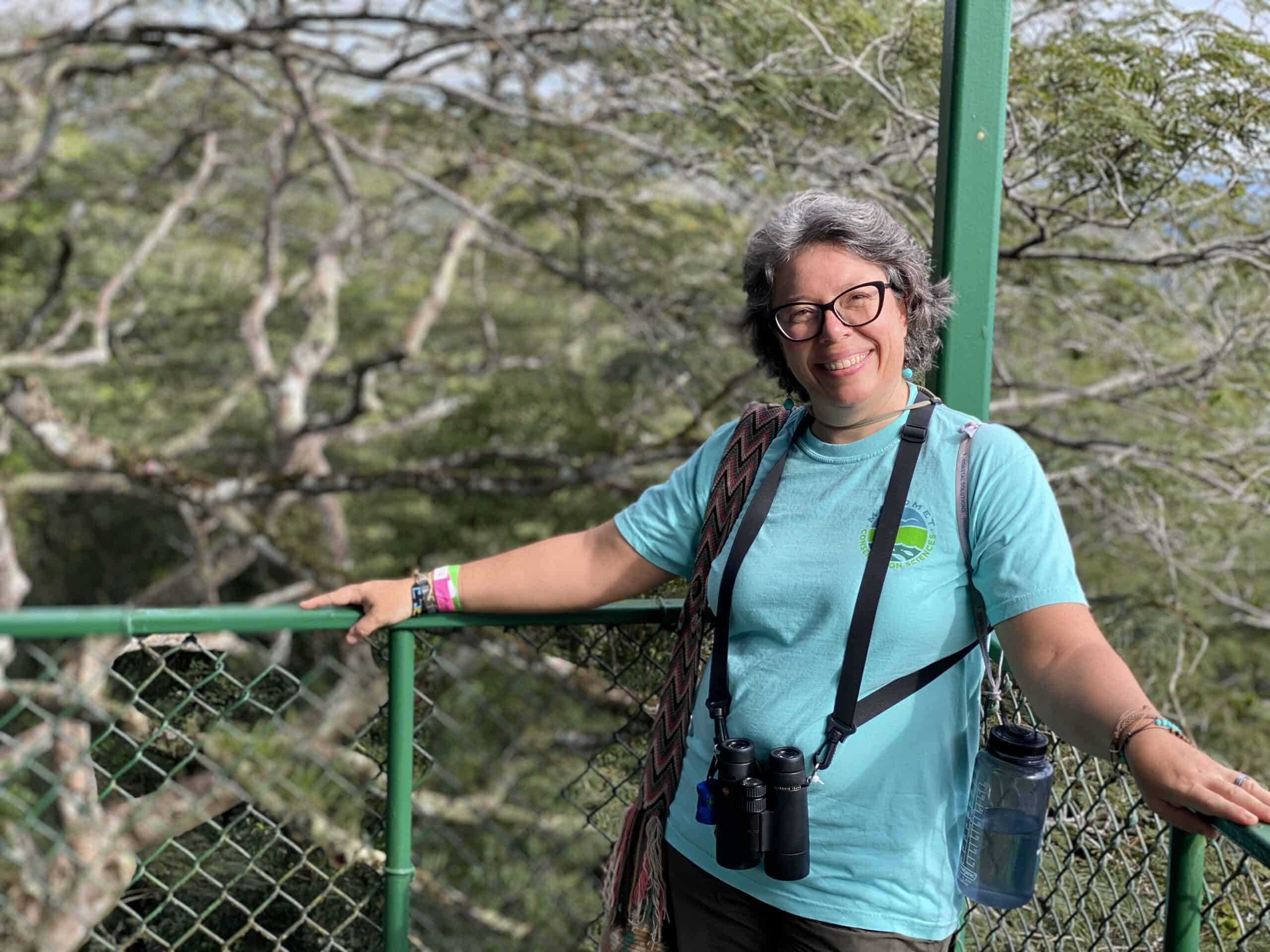
I work at Manomet Conservation Sciences as Director of Partnerships and Capacity.
What did you study? We’d love to learn about your academic path.
I studied Biology with a major in Zoology in Colombia, completed a Diploma in the Management of Threatened Species from the University of Kent (UK), and earned an MPhil in Conservation Leadership from the University of Cambridge (UK).
How did you become interested in bird conservation?
I come from a country with nearly 2,000 bird species, and from one of the cities with the highest bird diversity in the world (around 560 species), so it is hard not to be interested in birds. I always knew I did not want to pursue a traditional academic path. Beyond inspiring me, birds became a powerful entry point for promoting the conservation of other biodiversity, as well as the ecosystems and natural elements that humans depend on to survive.
Which Species Working Groups are you involved in?
I do not work with a single species, as my work is carried out at the flyway scale. However, through my role coordinating the Midcontinent Shorebird Conservation Initiative, my work focuses on species that migrate through and occur along the Midcontinental Flyway. To name a few: Buff-breasted Sandpiper (Calidris subruficollis), Lesser Yellowlegs (Tringa flavipes), Hudsonian Godwit (Limosa haemastica), Upland Sandpiper (Bartramia longicauda), Wilson’s Phalarope (Phalaropus tricolor), Andean Avocet (Recurvirostra andina), Magellanic Plover (Pluvianellus socialis), and Tawny-throated Dotterel (Oreopholus ruficollis).
In addition, through my role coordinating the Arctic Migratory Bird Initiative, I work with species such as Red Knot (Calidris canutus), Semipalmated Sandpiper (Calidris pusilla), Buff-breasted Sandpiper (Calidris subruficollis), Red Phalarope (Phalaropus fulicarius), and Red-necked Phalarope (Phalaropus lobatus).
Through this work, I am directly connected to the Lesser Yellowlegs and Buff-breasted Sandpiper working groups.
Tell us something interesting you’ve learned about the species you work with.
Conservation work is fundamentally about managing relationships and collaborating with people, not necessarily about working directly with birds.
What gives you hope for the future of bird conservation?
Capacity building in new generations gives me hope—particularly through programs such as the Manomet Small Grants for the Conservation of Neotropical Shorebirds, where we intentionally pass the torch. Seeing so many young people eager to learn, to be surprised, to ask questions, and to take responsibility for what comes next is incredibly encouraging. I am also hopeful about the conversations that are gaining space in conservation, including decolonization, gender equity, the role of women in conservation, and South–South collaboration.
Is there someone whose work has inspired you? Why?
New generations inspire me constantly, especially students at the university level. I am also deeply inspired by two Colombian conservationists: Dr. Luis Germán Naranjo, who was my mentor during university and the early stages of my professional career. His primary focus has always been birds—particularly waterbirds and shorebirds—and he conducted the first systematic study of shorebirds along the Colombian Caribbean coast in 1979. He introduced me to the fascinating world of shorebirds and taught me to appreciate their wonders with a sense of awe. In the early stages of my career, he was one of my greatest supporters, guiding and encouraging my professional growth while opening my eyes to the remarkable opportunities within international cooperation. Patricia Falk Fernandez has been — and will continue to be — a source of inspiration to me. She played a key role in shaping my professional development, particularly in working with communities and engaging diverse stakeholders. She helped refine my early interpersonal skills and contributed greatly to both my professional and personal growth. I am deeply inspired by her ability to build meaningful relationships and to drive change at all levels of society through social processes.
What is one lesson or message you would like to share with others in the R2R network?
Something we already know, but that is always worth repeating: bird conservation—especially for migratory birds—requires collaboration at the flyway scale. It cannot be done in isolation. Meaningful collaboration requires a deep understanding of local environmental, cultural, economic, and social contexts, so that conservation efforts become additive and supportive rather than a source of local conflict.