
R2R Species Recovery Progress Wheel
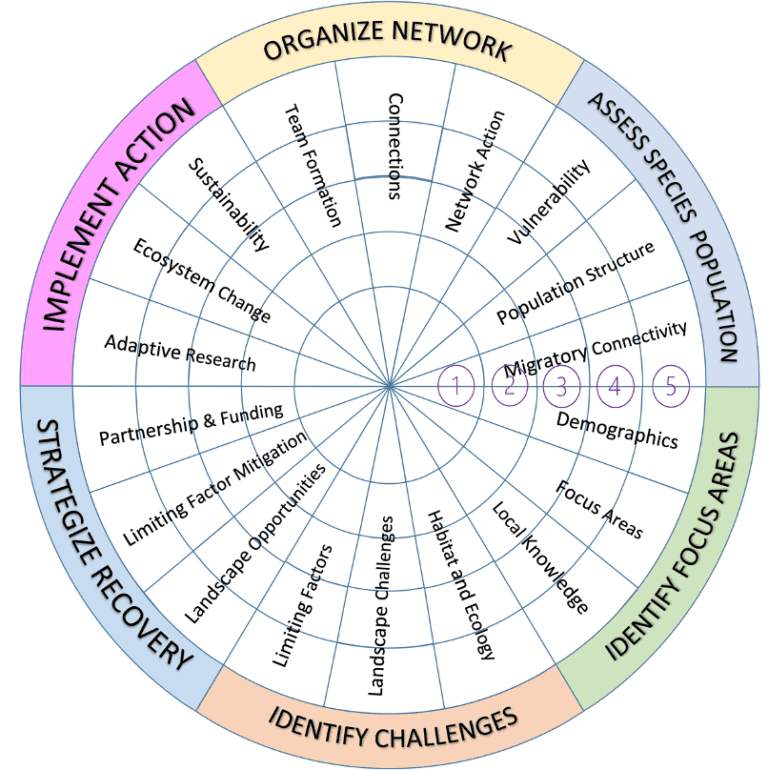
R2R’s Species Recovery Progress Wheel organizes biological, social science and human dimensions, co-production, and inclusivity criteria into six broad action categories that represent the major components of effective species recovery. Each category is divided into three segments, and each segment includes five specific criteria that describe key steps in the recovery process. Together, these steps comprise 90 criteria in a structure that is detailed enough to guide planning but still manageable for teams to use. The criteria are intended to provide progressive step-wise guidance, proceeding clockwise from Group Organization to Implementation and from the center outward (steps 1 to 5) in each of the segments.
The structure of the Wheel helps teams understand where recovery work is strong and where additional attention is needed. It supports collaboration by providing partners a shared language for discussing progress and planning next steps across disciplines. This tool is designed to be accessible in group settings and reflects the complexity of both biological and social processes that influence the recovery of species.
How to Use the Wheel
Species Working Groups can use the Wheel to assess how far a species has progressed across the key components of recovery and to visualize where recovery efforts can be focused next. The criteria in each segment represent key recovery activities ranging from understanding vulnerabilities and limiting factors to developing recovery plans, building partnerships, and carrying out management and monitoring. Moving through these steps guides teams as they document activities that are underway, have been completed, or will become future priorities.
The Wheel is designed to track species recovery progress and to provide practical guidance in the integration of efforts across biological and human dimensions. Although the Wheel is designed to be progressive, every species and working group is unique, and a team may indeed find that its assessment may not always populate the Wheel sequentially. Working groups can use the completed Wheel for a variety of purposes, including team and recovery organization, tracking recovery progress, strengthening grant proposals, as a gap analysis, or for strategic planning. The Wheel is not intended to score, rank, or otherwise assess the working group itself; rather, it is designed to facilitate shared understanding, coordination, and decision making.
Downloading the Wheel
Note about the Excel workbook: Please unzip the file before opening. When prompted in Excel, enable macros to ensure all features work properly.
Please send a copy of your completed assessment to r2r@georgetown.edu so that R2R can keep track of the Species Working Groups that have worked with the self-assessment tool.
Additional Resources
Explore the videos below to learn how the Wheel can support shared understanding, planning, and collaboration within your species working group.
The videos below highlight practical approaches to working with the Recovery Wheel. They feature recorded sessions, instructional guidance, and examples from partners who have used the Wheel in planning, evaluation, and collaborative engagement. These resources support teams at all stages and can be used alongside or independently from the live Forum Series.
Recovery Wheel Forum Series
The Recovery Wheel Forum Series includes recorded sessions that walk through each section of the Wheel, offering guidance, examples, and insights for species working groups applying the tool in their recovery planning.
Each session covered a different section of the Species Recovery Wheel:
- Organize Network
- Assess Species Populations
- Identify Focus Areas
- Identify Challenges
- Strategize Recovery
- Implement Action